Table of contents
- AED access in McKinney and why it matters
- What the school and fire department collaboration showed
- Practical emergency response lessons
- Who should pay attention
- FAQ
AED access in McKinney and why it matters
AED access in McKinney is gaining attention because cardiac arrest is a time-sensitive emergency. When the heart stops pumping effectively, every minute matters. CPR can help maintain blood flow, and an AED can analyze the heart rhythm and deliver a shock if needed. The goal is not simply to have devices available, but to place them where people can reach them quickly and use them without delay.
During CPR and AED Awareness Week, McKinney ISD and the McKinney Fire Department drew attention to a practical question many communities face: how do you make lifesaving equipment easier to locate, mount, and deploy in everyday spaces? That question is especially relevant in schools, parks, libraries, recreation centers, and other public settings where bystanders may be the first to respond.
What the McKinney collaboration showed
The local effort centered on students, educators, and fire department personnel working on a real-world design challenge. Fourth- and fifth-grade students studied the circulatory system, cardiac arrest, CPR, and AED use before creating ideas for mounting smaller AED units in public cabinets. Their work connected classroom learning with public safety planning.
That kind of project matters because emergency response is not only about possessing the right equipment. It is also about whether the equipment is placed in a location that makes sense during a crisis. If an AED is visible, clearly stored, and easy to retrieve, the chances of faster use improve. A slower response can mean fewer options for the person in cardiac arrest.
The McKinney Fire Department has already placed more than 150 AEDs across the community, including in parks, libraries, recreation centers, and police vehicles. Local efforts like this help narrow the gap between the moment someone collapses and the moment lifesaving care begins. That gap is where CPR, first aid awareness, and fast decision-making can make a meaningful difference.
What people can learn from AED access in McKinney
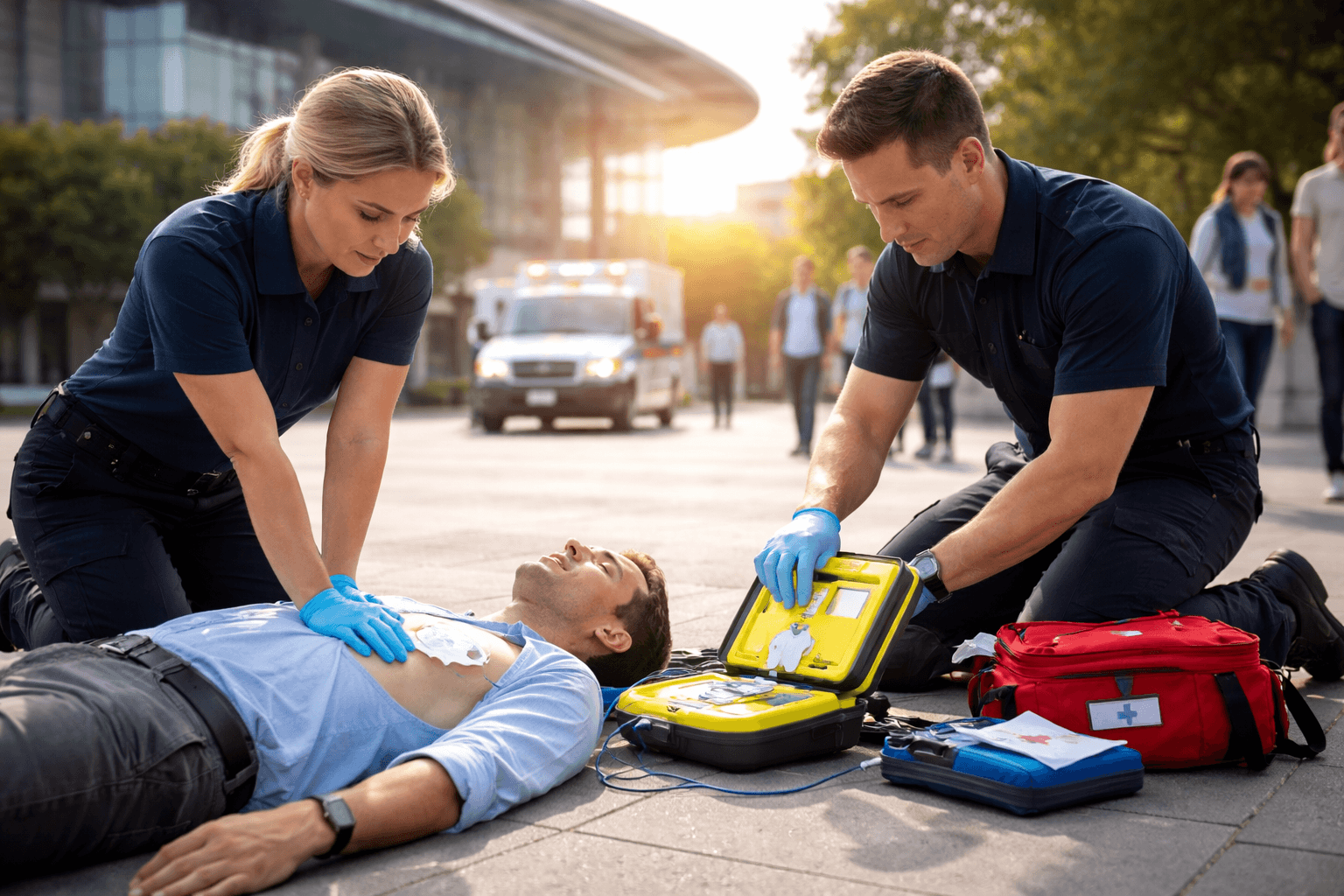
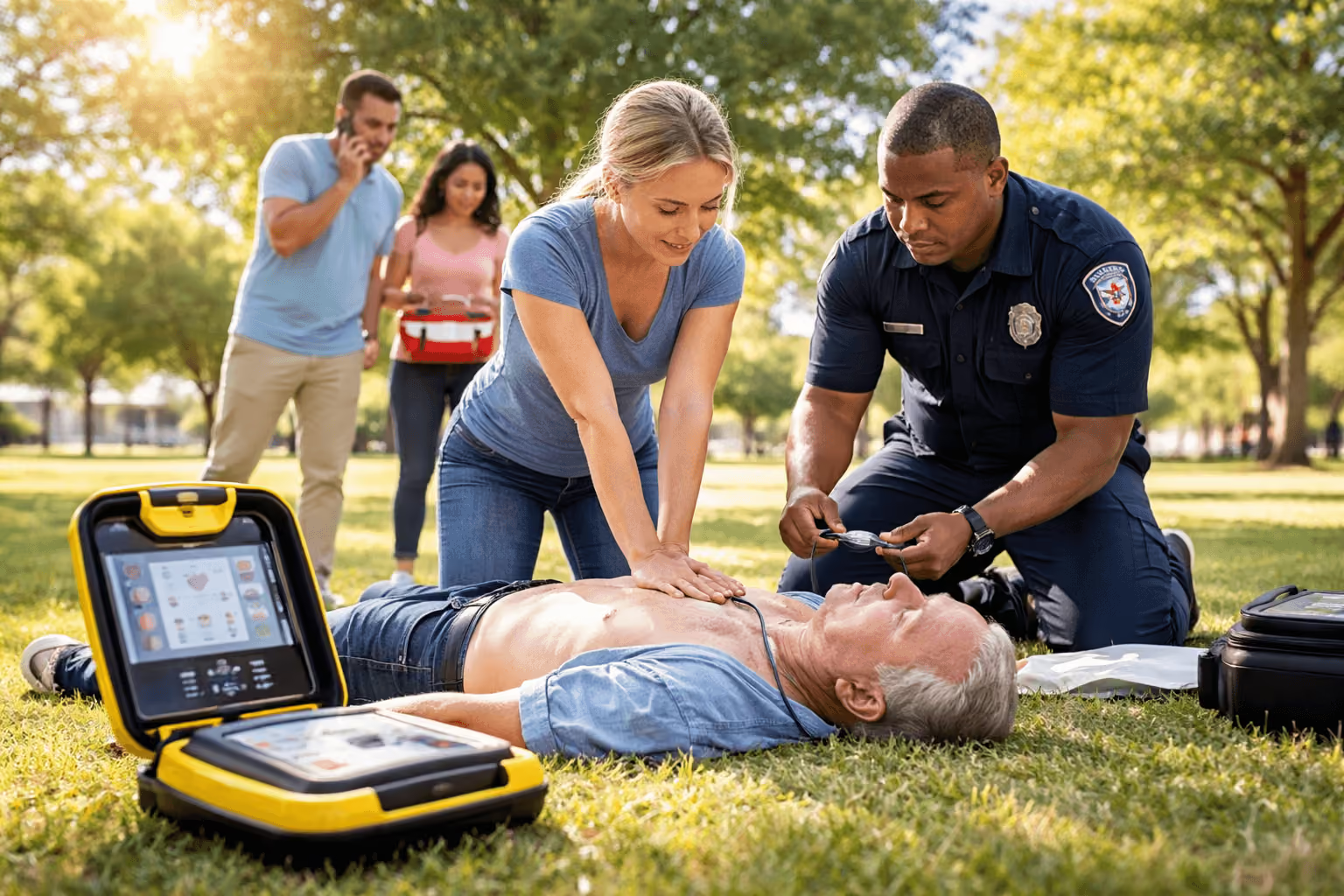
The main lesson from AED access in McKinney is straightforward: preparedness works best when people can act quickly. In a cardiac arrest emergency, bystanders may need to begin compressions, send someone to retrieve an AED, and call 911 right away. That sequence is often the difference between confusion and coordinated action.
Concrete examples help explain why access matters. In a school hallway, an AED mounted near a main entrance is easier to reach than one stored deep inside a locked office. In a park or recreation center, a clearly marked device can shorten the time it takes for a coach, parent, or visitor to respond. In a police vehicle or public facility, having the device ready at the point of need can reduce avoidable delays while emergency crews are en route.
Quick access also supports the first few minutes before advanced medical care arrives. CPR helps preserve circulation. The AED provides guidance and, when appropriate, a shock that may help the heart return to a usable rhythm. These steps are widely recognized as core parts of emergency response, and they work best when the community is ready to use them.
For added context, readers can review McKinney ISD’s public announcement about the student project and the McKinney Fire Department’s communications about AED deployment and readiness. These local references help show that the effort is part of an ongoing citywide approach rather than a one-time event.
This article is for general educational purposes only and is not a substitute for professional medical advice, diagnosis, treatment, or certified CPR training. In an emergency, call 911 immediately.
Who should pay attention to AED placement and CPR readiness
This news is relevant to teachers, school staff, parents, coaches, coaches, students, office managers, and anyone responsible for a shared space. It also matters to healthcare professionals and workplace safety coordinators who may help evaluate emergency plans, equipment placement, and response protocols.
Families should also take note. Most cardiac arrests happen at home, so AED awareness should not be limited to public buildings. People who learn CPR and first aid are often better prepared to respond while waiting for EMS. Even if a person never uses an AED, knowing where one is located and how to begin compressions can help reduce hesitation in a crisis.
Why CPR, AED, and first aid training still matter
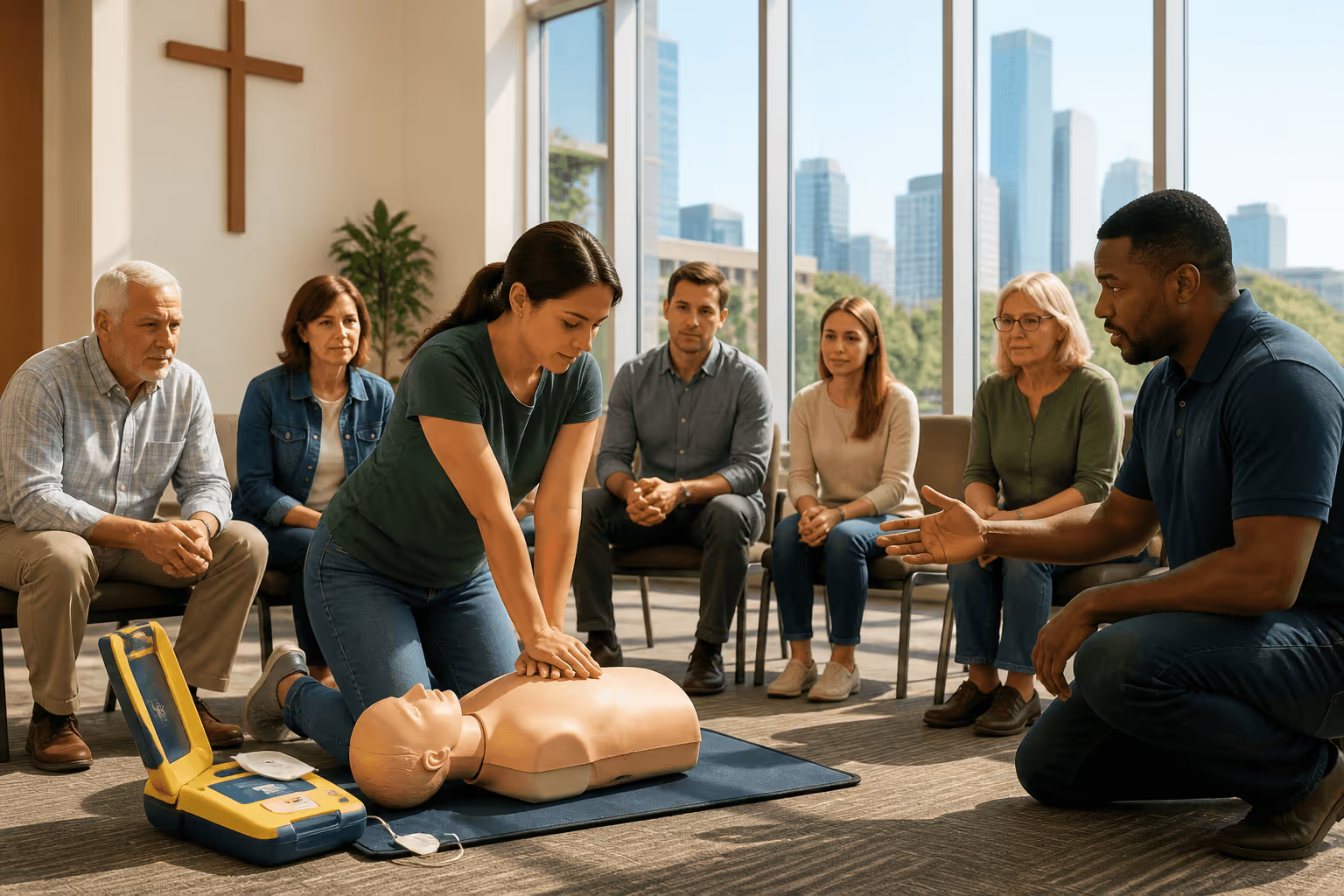
Equipment alone does not create readiness. A community also needs people who understand when to act, how to start CPR, and how to follow the AED prompts. Training reduces uncertainty. It also helps people recognize that in a suspected cardiac arrest, the safest response is to move quickly, get help, and follow the device instructions.
That is why local AED planning and CPR education belong together. Schools can help young people build awareness early. Fire departments can guide placement and emergency planning. Businesses and community groups can make sure staff know where devices are stored. Together, these steps support stronger emergency response across McKinney.
Benefits of choosing CPR Certification Labs
CPR Certification Labs offers CPR, BLS, ACLS, AED, and first aid training for people who want clear, practical instruction. For healthcare professionals and community members alike, the value of training is confidence: knowing what to do, when to do it, and how to support a person in distress until emergency responders arrive.
Local learners in McKinney can use training to strengthen readiness in schools, offices, childcare settings, gyms, and community spaces. The goal is not promotion; it is preparation. When more people understand emergency response basics, more places become safer places to work, learn, and gather.
Nearby local reference points in McKinney
McKinney residents may think about AED access in familiar locations such as public libraries, parks, recreation centers, school campuses, and city vehicles. These are the kinds of settings where an accessible AED can be especially useful because many people gather there and emergency needs can arise without warning.
If you want local CPR or AED training, visit our McKinney - Tucker Hill office page for schedule and contact details.
For those following the community conversation, the broader takeaway is clear: better AED placement, stronger CPR awareness, and coordinated emergency response planning can improve the odds when cardiac arrest occurs.
FAQ
Where should AEDs be placed in public buildings?
AEDs should be placed where people can find them quickly, such as near main entrances, central hallways, or other high-traffic areas. Clear signage and fast access are important.
What should I do first in a suspected cardiac arrest?
Check the scene, call 911, start CPR if trained, and send someone to get an AED. Follow the device prompts as soon as it is available.
Who can use an AED?
Most AEDs are designed for use by lay rescuers as well as trained responders. The device gives voice instructions, which can help guide a user through the process.
How does CPR help while waiting for an AED?
CPR helps maintain blood flow to the brain and other vital organs until the AED arrives or EMS takes over. It is a key part of emergency response.
Is first aid training useful for AED readiness?
Yes. First aid training helps people respond more calmly in emergencies, communicate clearly, and support the person until advanced care arrives.
Can students really contribute to public safety projects?
Yes. In McKinney, students helped think through practical design questions for AED mounting. That kind of project can build awareness and improve real-world problem solving.
About our McKinney - Tucker Hill office
- Address: 7200 W University Dr, Suite 218
- Phone: (903) 627-2841
- Email: McKinney@cprcertificationlabs.com
- Hours:
Monday to Friday: 6am - 8pm
Saturday to Sunday: 7am - 5pm